

Introduction
Financial industry marketing and communications compliance teams face a perfect storm: channel sprawl, AI-driven content velocity, and evolving regulations. In fact, 61% of surveyed compliance executives report rising review volumes, according to Saifr’s survey of U.S. financial marketing and compliance leaders. And as we cited in a previous blog on the topic, over half of compliance leaders (56%) said their teams need 4 to 5 days to review a piece of content and 39% need 6 to 10 days.
For marketing and compliance professionals, the volume of content creation today is putting immense pressure on teams.
On the marketing side, fragmented media consumption and personalized advertising channels are fueling faster omni-channel campaign cycles. This is leading marketers to scramble to produce an increasingly channel-diverse array of high-quality, compliant content in a timely manner, prioritizing speed to market. To meet the moment, many marketing departments are turning to generative AI tools to help create more channel-specific content faster. Moreover, many firms are experimenting with user-generated content, where influencers create videos and other content based on their experiences with a product or service. Skipping the compliance review for any of this content is non-negotiable in a regulated industry.
On the compliance side, review teams are also challenged with rising workflow volumes and must consider the disclosures related to certain channels and formats (e.g., video, image, and social media content), as well as any new industry regulations. In financial services for example, FINRA is taking a closer look at GenAI outputs. In the life insurance industry, regulators have tight enforcement for what counts as advertising. Marketing approaches like user-generated content also add creators to the mix who may not be fluent in regulatory requirements, further increasing the potential for regulatory non-compliance and more rounds of review.
However, the greater challenge for both teams is managing and scaling workload volumes and complexity with a traditional, manual approach.
Legacy review processes may cost firms time, money, and more…
Many of today’s review processes are based on iterative, manual workflows that rely on the individual knowledge and skill of the reviewer. These piecemeal, human-led reviews lack the automation and shared intelligence of modern, solution-assisted content review streams, trapping knowledge and workflow within individual siloes and slowing the time to market.
Our survey found that these siloed systems create a visibility gap. For example, surveyed compliance leaders estimate reviewing around 66% of created content, while marketing leaders report that only about 59% goes through compliance review. This disconnect may prevent members of both teams from having a full view and understanding of all the requirements and activities necessary to create, review, and bring promotional content to market.
Additionally, manual handoffs among people and tools in legacy processes create the potential for significant bottlenecks and version sprawl, uneven documentation, and incomplete audit trails, making decisions harder to defend, increasing the chances of error, and leading to a loss of trust between teams.
The gaps and disconnects can also contribute to extended cycle times and inefficiencies, inhibiting the velocity needed to compete in increasingly competitive markets. More importantly, these disconnects don’t just slow operations. They can introduce measurable operational and reputational risk, especially when content is published without full compliance visibility.
Traditional approaches to scaling compliance, such as adding headcount or extending timelines, are no longer sustainable. To keep pace with content demands without increasing risk, firms should think about fundamentally changing their approach to content review.
For these reasons, financial industry firms are looking for technologies that can help shorten the turnaround time for marketing content review while helping review teams ensure regulatory compliance. Fortunately, AI-based tools hold promising efficiency gains for both the pre- and post-review stages of marketing content creation. And unlike general-purpose AI tools, contextual AI models trained on industry-specific policies, regulatory frameworks, and communication standards can evaluate content not just for language, but for compliance within their intended use and audience. When combined with human-in-the-loop review capabilities, these tools can help transform the compliance review process from submittal to sign-off.
Transforming the pre-review workflow with contextual, evidence-based AI
Faster, more compliant content doesn’t just reduce delays, it enables marketers to launch campaigns on time, adapt messaging faster, and stay competitive in crowded digital channels. Contextual AI helps make this possible by streamlining and strengthening compliance review processes.
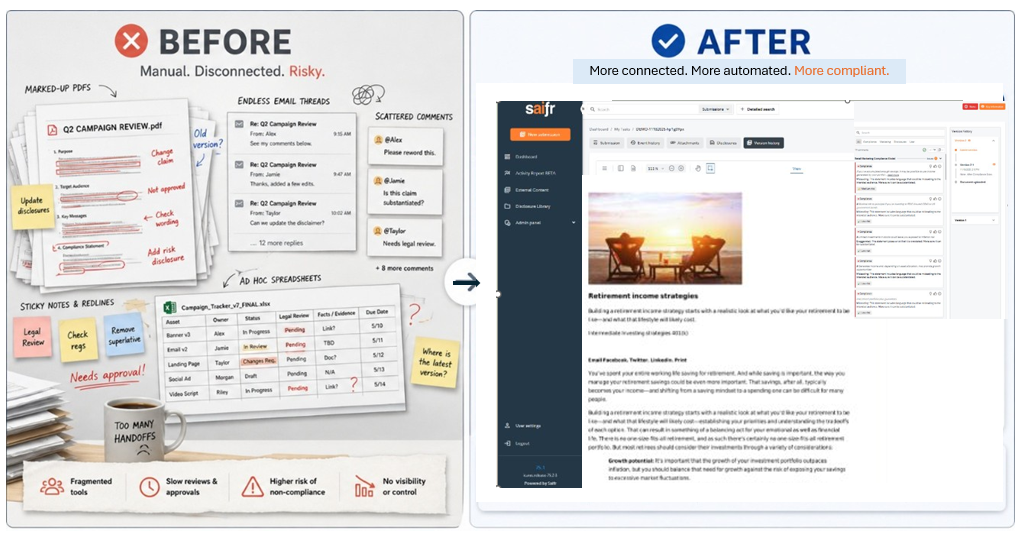
For illustrative purposes only
Digitally native contextual AI marketing compliance review tools help firms streamline pre- and post-review workflows by replacing the chaos of PDFs, email threads, and ad hoc spreadsheets with more consistent processes for policies, guardrails, evidence links, and role-based checkpoints.
Contextual AI models use natural language processing and machine learning to read and understand marketing and advertising content within the context of their intended channels, audiences, and relevant industry policies. AI-driven marketing reviews can also fit nicely into an automated, platform-driven workflow, reducing the number of manual handoffs and tools needed for pre-compliance review.
What is perhaps most important is the quality of the AI model. Models that are well-trained on the nuances of industry and customer segments and are purpose-built to flag potentially non-compliant material based on evidence can help marketers accelerate compliant content production in the pre-review stage—getting to a cleaner first draft with fewer revisions and consistent quality control while adhering to relevant compliance requirements.
This does not mean that humans are no longer involved in the process. Necessary human oversight (i.e., “human-in-the-loop”) should be embedded into the pre-review process with clean handoffs to and from machine, especially for final approvals.
Transforming post-review workflows with consistent, auditable approvals
Process transformation doesn’t end with pre-review workflows. Contextual AI helps compliance teams flag potentially non-compliant content and helps automate post-review workflows in several ways:
- Comparing changes: Enabling side-by-side comparisons with rationale captured for each change.
- Structuring findings: Providing reasons why items were flagged, with policy references and suggested remediations in-line.
- Enabling consistency of responses: Flagging issues and providing explanations for flags based on a pool of shared, curated knowledge.
- Auditability by design: Capturing timestamps, versions, approver history, and exportable logs as part of the official record.
- Re-checking for protocol changes: Updating models quickly when regulatory rules change.
These capabilities not only improve consistency, but also help make compliance decisions easier to explain, validate, and defend under regulatory scrutiny. Together, the capabilities shift compliance review from a fragmented, reactive process to an integrated, proactive workflow spanning content creation through final approval.
The future of compliant content creation isn’t slower—it’s smarter
With contextual AI embedded across pre- and post-review workflows, financial services firms can empower marketers to move faster while giving compliance teams greater confidence in every decision. The result is a more connected, transparent process that reduces rework, improves consistency, and helps both teams deliver better outcomes together. As the volume and complexity of work intensifies, organizations that rethink their review processes can be best positioned to scale compliant content creation, reduce risk, and move faster than their competition.
Sources:
- eBook, “Insights survey: The struggle is real: Overcoming hurdles in content creation and review”
- Article, “Compliance concerns: Workloads, knowledge gaps, and separate systems”
- Article, “Building a GenAI Governance Framework: Takeaways from FINRA’s 2026 Oversight Report”
- Article, “Compliance requirements for life insurance and annuity products”
The opinions provided are those of the author and not necessarily those of Saifr or its affiliates. The information is general and educational in nature, is for informational purposes only, and should not be construed as legal advice.
1267988.1.0